On this page
- What is Discover Scuba Diving?
- Who can do a first dive?
- Your first dive, step by step
- Ears, mask and nerves: what first-timers worry about
- Hand signals you will learn
- What you might see underwater
- Daymaniyat Islands dive sites
- When is the best time to dive?
- Flying after diving
- What it costs
- Loved it? What comes next
- Frequently asked questions
- Book your first dive
Short answer: yes, you can scuba dive at the Daymaniyat Islands without a certificate. A Discover Scuba dive is a first dive for beginners: an instructor explains the equipment, you practise a few basic skills, and then you dive for about 20 to 30 minutes, no deeper than 12 metres, with the instructor supervising you directly. With us it costs 60 OMR plus VAT, including the full kit and a wetsuit, on a trip of about 4.5 hours from Seeb Marina in Muscat. You need to be 14 or older, sober, and to fill in a medical questionnaire.
This guide explains how a first dive works, who can do it, how to deal with your ears, the mask and nerves, what you might see, the dive sites, and what comes next if you love it.
Your first dive at a glance
- Certificate needed?
- No
- Minimum age
- 14
- Depth
- No deeper than 12 metres
- Time underwater
- About 20 to 30 minutes
- The trip
- About 4.5 hours from Seeb Marina, Muscat
- Price
- 60 OMR plus VAT (63 OMR), full kit and wetsuit included
What is Discover Scuba Diving?
Discover Scuba Diving is an introduction to diving, not a course and not a certification. It lets you try breathing underwater with an instructor beside you, without any training beforehand. It has three parts: a briefing on the equipment and safety, a few basic skills practised in shallow water, and a short guided dive on the reef.
With some training agencies, a logged first dive can count towards an Open Water course if you start that course within about a year. If you think you might go on to learn, tell your instructor before the dive.
Who can do a first dive?
- Age 14 or older. Some dive centres take younger children; our minimum is 14.
- No experience needed. You don’t need to have dived or snorkeled before.
- A medical questionnaire. You fill it in before the dive, as part of the safety and liability form.
- Sober. No alcohol before diving.
- Non-swimmers: some can take part, but it is not guaranteed. The instructor checks your confidence and that you can do the safety exercises before you dive.
- The instructor decides on the day. If they judge it isn’t safe for you to dive, you won’t dive that day.
See a doctor before booking if you have
- Asthma, or a heart or lung condition.
- Had surgery in the last 12 months, or take prescription medicine.
- Ear or sinus problems, or a cold or blocked nose on the day.
- Epilepsy, fainting, migraines or a past head injury.
- Diabetes, or back or spine problems.
- Panic attacks or anxiety in closed spaces.
- Pregnancy: don’t dive while pregnant.
These are the kinds of questions on the standard diver medical questionnaire. A “yes” doesn’t always mean you can’t dive, but you may need a doctor to sign a form first. If in doubt, message us before you book.
Your first dive, step by step
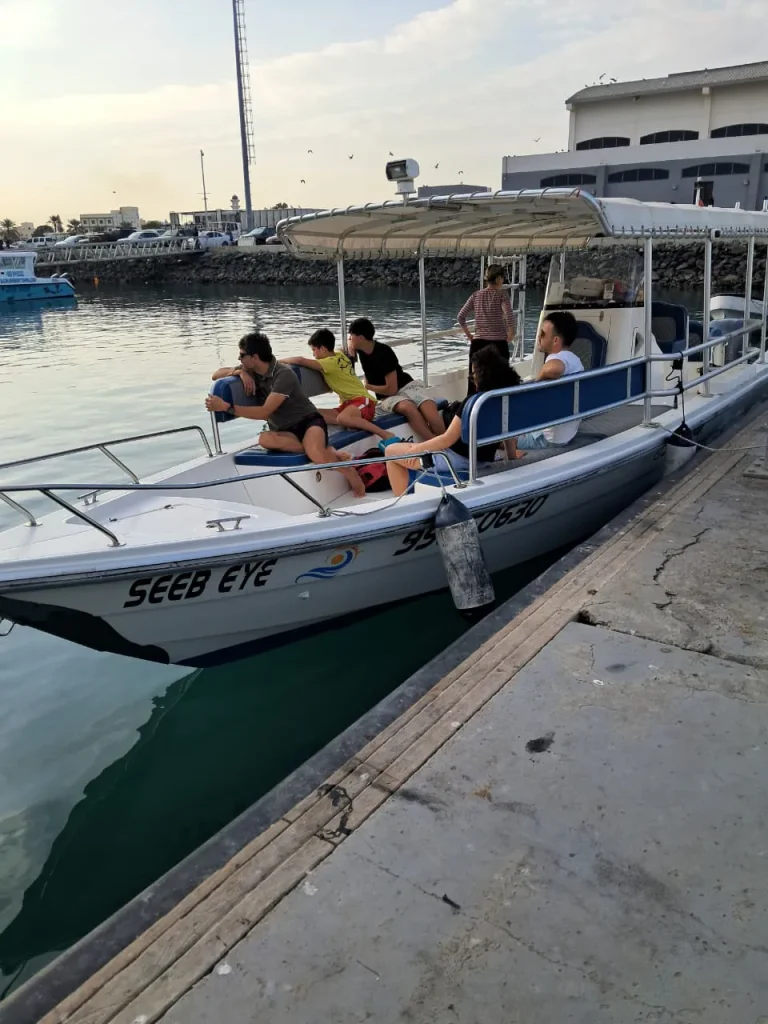
1. Meet the team at Seeb Marina
The dive team confirms your exact meeting time when you book. Parking at the marina is free. The boat ride to the islands takes 25 to 30 minutes.
2. The briefing
Your instructor explains the equipment (the tank, the jacket that controls how you float, and the regulator you breathe from), how to breathe, how to equalise your ears, and the hand signals you will use underwater.
3. Basic skills in shallow water
Before going deeper, you practise a few basic skills in shallow water, such as breathing slowly through the regulator, getting a little water out of your mask, and finding your regulator again if it comes out of your mouth.
4. The dive
You go down slowly with your instructor, equalising your ears as you go, to a maximum of 12 metres. The dive usually lasts 20 to 30 minutes, depending on how you feel and the conditions. Your instructor supervises you directly the whole time and controls the pace.
5. After the dive
Back on the boat, you can snorkel, swim or relax for the rest of the trip, depending on the dive schedule. Sandwiches, snacks, water and juice are on board.
Ears, mask and nerves: what first-timers worry about
Your ears
As you go down, the water pressure pushes on your ears, a bit like landing in a plane. You relieve it by equalising: swallow, or pinch your nose and blow very gently. Do it early, before you feel anything, and often during the first few metres. It should never hurt: if it does, signal to your instructor, go up a little and try again. A cold or a blocked nose makes equalising hard, so don’t dive with one.
Water in your mask
A little water in the mask is normal. The trick is to keep breathing slowly through your mouth: water near your nose can make you want to hold your breath. Your instructor shows you how to clear it in shallow water first.
Breathing and nerves
Breathing through a regulator feels strange for the first minute, then most people relax. Breathe slowly and deeply, and never hold your breath, especially while going up. If you feel nervous, tell your instructor in the briefing: you can take your time at the surface, stay shallow, or end the dive whenever you want.
Hand signals you will learn
| Signal | What it means |
|---|---|
| Thumb and finger in a circle | OK |
| Flat hand rocking side to side | Something is wrong (then point to the problem, for example your ear) |
| Thumb up | Go up. It does not mean “good” underwater. |
| Thumb down | Go down |
Your instructor goes through the signals with you before the dive.
What you might see underwater
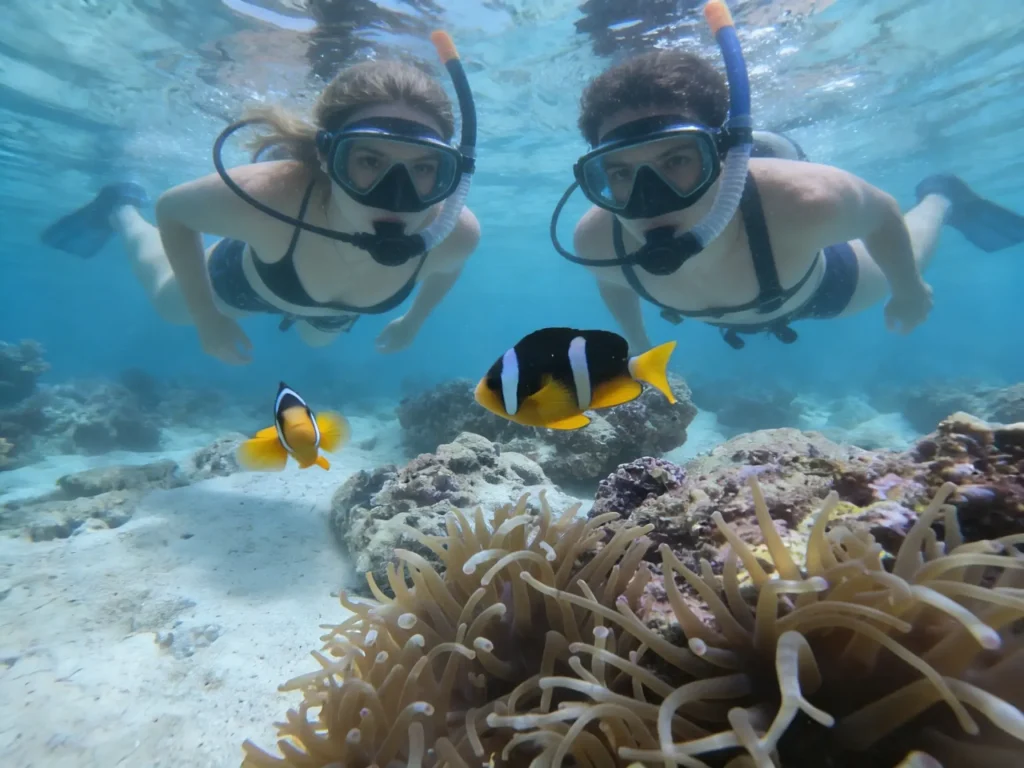
The Daymaniyat Islands have been a protected nature reserve since 1996, and the reef shows it. Green and hawksbill turtles are very common. Divers also often see reef sharks, leopard sharks, large moray eels, stingrays, barracuda and many reef fish, over soft and hard coral. From June to September, whale sharks are sometimes seen. Everything is wild, so nothing is guaranteed, and nobody touches the coral or the animals.
Daymaniyat Islands dive sites
There are more than 12 dive sites around the islands: steep walls, shallow coral gardens and sandy bays. The dive team chooses the site on the day, by the sea, the current and the visibility; on a first dive you stay within 12 metres. Visibility is usually 10 to 20 metres, though a sudden cooler layer of water can reduce it.
Sites that divers often mention include:
- Aquarium: big rocks and colourful coral, popular for sharks, rays and schools of fish.
- Police Run: a wall full of holes and overhangs.
- Garden of Eden: a wall covered in soft and hard coral, often with a gentle current.
- Three Sisters: large boulders covered in soft coral.
Deeper walls are for certified divers. On a first dive you stay within 12 metres, where the light is brightest and the colours are strongest.
When is the best time to dive?
Diving runs all year. October to May is the peak season, with pleasant water and the best visibility. The sea is about 23 to 26 °C from December to March and 29 to 31 °C from May to October, and a wetsuit is included either way. See our guide to the best time to visit for every month.
Flying after diving
Plan your dive so you don’t fly too soon after. We ask divers to wait at least 18 to 24 hours before flying. Divers Alert Network’s minimum guidance is 12 hours after a single dive and 18 hours after several dives, and waiting longer is always safer. Book your dive early in your trip rather than on your last day.
What it costs
Included: the boat from Seeb Marina, the instructor, the briefing, one guided dive, the full kit (wetsuit, BCD, regulator, mask, fins and weights), the reserve permit, snorkeling equipment when available, snacks, water and soft drinks. Not included: a second dive, certification, hotel transport and towels.
Loved it? What comes next
To dive without an instructor beside you, you need a certification, usually an Open Water course with a dive centre. It takes a few days, and you may need a doctor’s clearance for it. Once you are certified, with any agency, you can join our two guided dives for certified divers, down to a maximum of 30 metres within your certification level.
Frequently asked questions
Can I scuba dive at the Daymaniyat Islands without a certificate?
Yes. A Discover Scuba dive is for beginners with no certificate: after a briefing and a few basic skills, you dive for about 20 to 30 minutes, no deeper than 12 metres, with an instructor supervising you directly.
How much is Discover Scuba Diving in Muscat?
With us, 60 OMR per person plus 5% VAT (63 OMR in total), including the boat from Seeb Marina, the instructor, the full kit with a wetsuit, the reserve permit, snacks and drinks.
What is the minimum age for a first dive?
Our minimum age for Discover Scuba is 14. Certified divers of any age can join our guided dives with a valid certification.
Do I need to be able to swim to scuba dive?
It helps. Some non-swimmers can take part, but it is not guaranteed: the instructor checks your confidence and that you can complete the safety exercises before you dive.
How deep is a Discover Scuba dive?
No deeper than 12 metres. Most of the colour and life on the reef is in this shallow, sunlit water.
Is Discover Scuba Diving a certification?
No. It is a supervised introduction. To dive on your own with a buddy you need a certification course, such as Open Water.
How long should I wait to fly after diving?
We ask divers to wait 18 to 24 hours. Divers Alert Network’s minimum is 12 hours after one dive and 18 hours after several, and longer is safer.
Does Oman have good scuba diving?
Yes. Around the Daymaniyat Islands, a protected nature reserve off Muscat, divers often see turtles, reef and leopard sharks, morays, rays and coral, with visibility usually 10 to 20 metres. Diving runs all year, best from October to May.
Which dive sites are at the Daymaniyat Islands?
More than 12, including walls, coral gardens and sandy bays. Sites divers often mention include Aquarium, Police Run, Garden of Eden and Three Sisters. The dive team chooses the site on the day by the conditions.
Book your first dive
See our scuba diving trip, or message us on WhatsApp with your date and how many people want to dive. Travelling with snorkelers? They can come on the same boat when the schedule allows: just ask.
Take the trip
60 OMR per adult + VAT
- About 4.5 hours
- Seeb Marina
- All year
Take the trip
70 OMR per adult + VAT
- About 4.5 hours
- Seeb Marina
- All year
Take the trip
30 OMR per adult, 15 OMR per child + VAT
- About 4 hours
- Seeb Marina
- All year